
Home Phone Service by Address
Find the local phone company at your address and every cable and fiber company there that sells home phone service. We match your address to the FCC’s phone company boundaries, so you see who actually serves your home, not a list for your whole ZIP code.
Enter an address or ZIP code below:
Looking for internet service instead? See internet providers by address.
How it Works
Every address has a local phone company: the carrier that has traditionally provided landline service there. We find yours from the service area boundaries filed with the FCC, then list the cable and fiber companies at your address that sell home phone service, with the product each one sells. A ZIP code gives a quick answer; your full address gives the exact one.
America’s Local Phone Companies
The FCC divides the country into 1,419 phone company service areas. Each one has a local phone company, the carrier that has traditionally been responsible for landline service there. Here is who they are.
Who Is the Local Phone Company Where You Live?
Each colored area is a phone company service area on file with the FCC. The smallest phone companies, about 690 rural carriers the FCC regulates as rate-of-return carriers, serve 3.5% of U.S. residents, but their service areas cover 37% of the map.
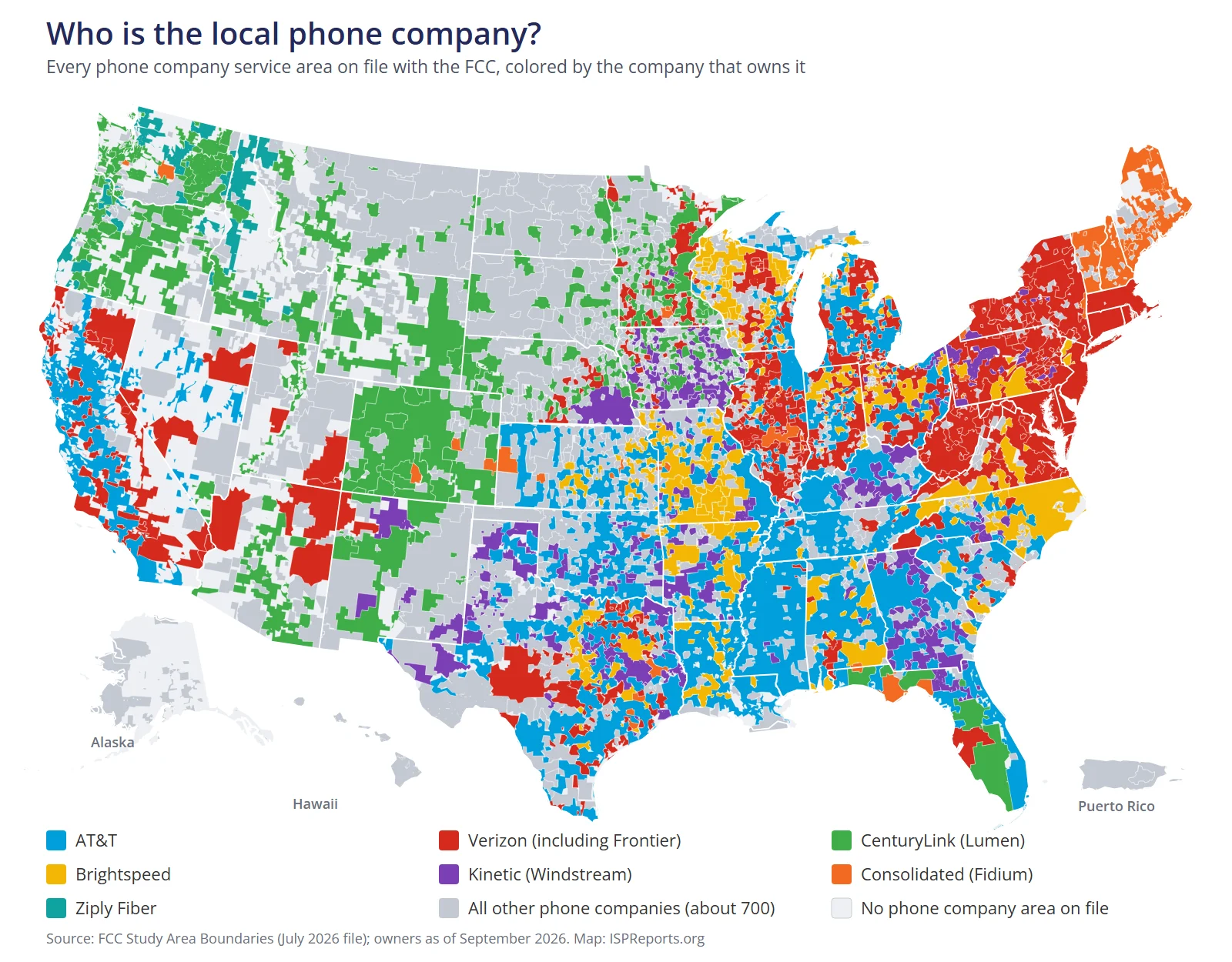
Free to use with credit to ISP Reports and a link to this page. Select the map for the full-size image.
The Largest Local Phone Companies
The share of U.S. residents whose local phone company each one is, from the FCC’s boundaries and 2020 Census population. Frontier has been part of Verizon since January 2026.

42.9% of residents

18.3% of residents

13.0% of residents

11.0% of residents

4.1% of residents

2.5% of residents

1.4% of residents

1.0% of residents
Local Phone Companies by State
Iowa has 123 local phone companies, the most of any state; Hawaii has two and Washington, D.C. has one. Darker states have more phone companies. Hover over or tap a state to see how many it has, the largest one and where to take questions or complaints about phone service. The table below lists every state.
Your Options for Home Phone Service
A traditional landline is no longer the only way to keep a home phone. Here is how the options compare.
| Option | Who sells it | Works in a power outage | Needs internet service |
|---|---|---|---|
| Traditional landline | Your local phone company, where it still sells copper service | Usually, with a corded phone: the phone company powers the line | No |
| Digital home phone | Cable and fiber companies, and phone companies replacing copper | Only with a backup battery, which the provider must offer to sell you | Usually sold with internet |
| Internet phone service | Services such as Ooma and Vonage | Only if your modem and router have backup power | Yes |
| Cellular home phone | Wireless carriers | Only with a backup battery in the base, which the provider must offer to sell you | No, it uses the cell network |
FCC rules require providers of digital and cellular home phone service to offer a backup battery that lasts at least 8 hours, and one that lasts 24 hours (47 CFR 9.20). Before you switch, check that your medical alert device, home security alarm, fax machine or TTY works on the new service.
If Your Landline Is Being Discontinued
Phone companies are replacing old copper networks with fiber and wireless service. AT&T says it plans to retire copper across most of its territory by the end of 2029 (AT&T, December 2024). In March 2026 the FCC gave phone companies blanket approval to stop selling copper-based phone service to new customers and sped up the process for ending it: an application to discontinue a service can now take effect automatically after 31 days unless the FCC steps in (FCC, March 26, 2026). In September 2026 the FCC took Verizon’s request to end copper phone service in parts of nine states off that automatic track for a closer review (FCC, September 25, 2026).
If you get a letter saying your landline service is ending:
-
Find out what replaces it
- The phone company must tell you about replacement options before it asks the FCC to end your service. Ask what the replacement costs, whether it needs internet, and what happens when the power goes out.
-
Ask for a backup battery
- Digital and cellular home phone service needs power at your home, so ask for the backup battery your provider must offer.
-
Check the devices on your line
- Medical alert devices, home security alarms, fax machines and TTY devices may not work the same way on a digital line. Ask your provider or the device maker before the switch.
-
Tell the FCC if you object
- The notice from your phone company must explain how to comment to the FCC and by when (47 CFR 63.71).
-
Contact your state utility commission
- Some states require the local phone company to keep offering phone service. California’s utility commission, for example, turned down AT&T’s request to end that duty in 2024 (CPUC). Your state utility commission can tell you what applies where you live.
-
Ask about help with the bill
- Households that qualify can get a monthly discount on phone or internet service through the federal Lifeline program.
For Consumer Advocates, Journalists and Libraries
This lookup, the map and the state table are free to use. Link to this page, and use the map with credit to ISP Reports. We update them when the FCC publishes new phone company boundaries.
Suggested citation: ISP Reports, “Home Phone Service by Address,” https://ispreports.org/home-phone-providers-by-address/, based on FCC Study Area Boundaries (July 2026).
Need a list for your state or community? Contact us.
Frequently Asked Questions
-
Can you still get a landline?
- In most places, yes, but what you can order depends on your address. Your local phone company is the incumbent carrier for traditional phone service in its area, though some now offer a digital or wireless home phone instead of a new copper line. Enter your address above to see who serves you.
-
Who offers landline service in my area?
- Every address has a local phone company. Enter your address above and we will show it, along with the cable and fiber companies there that sell home phone service.
-
Can I get a landline without internet?
- Often, yes. Many local phone companies sell basic phone service on its own, while most cable and fiber companies sell home phone as an add-on to internet. Internet phone services need a broadband connection.
-
Is my landline going away?
- Some phone companies are replacing copper networks with fiber or wireless service, and they must tell customers about replacement options before they end a service. See if your landline is being discontinued.
-
Will my home phone work in a power outage?
- A traditional copper line is powered by the phone company, so a corded phone on it usually keeps working when your power is out. Digital, internet and cellular home phone services need power at your home, so ask your provider about a battery backup.
-
Is there help paying for phone service?
- Yes. Lifeline is a federal program that gives qualifying low-income households a monthly discount on phone or internet service. Learn more at lifelinesupport.org.
-
Where do these numbers come from?
- Phone company service areas come from the FCC Study Area Boundaries (July 2026 file), with owners updated for sales since then, such as Verizon’s purchase of Frontier. Shares of residents count 2020 Census population by block group. Providers at your address come from the FCC Broadband Data Collection at your census block.
-
How accurate is this?
- In our checks across five states, the company named in the FCC’s boundaries also offers wired service in the same area for 97 to 99 percent of residents. ZIP code answers are approximate because a ZIP code can span more than one phone company’s area; your full address gives the exact answer.